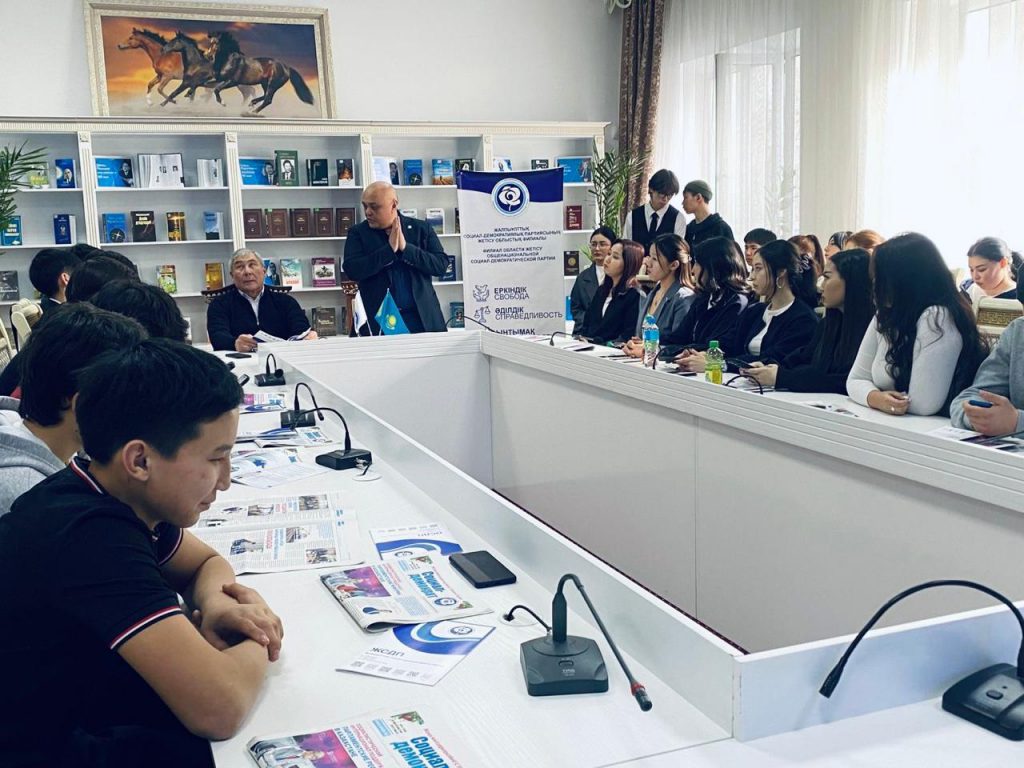
А meaningful and substantial meeting was held at the Saken Seifullin Central Library under the theme “Saken’s Legacy — A Path Connecting the Nation.” The event became not only a tribute to history, but also an important platform that brought together the past and the present, ideas and concrete action. The meeting was specially attended by Zhasulan Myrzhakhmetovich Mukamanov, a representative of the Zhetysu Region branch, who elaborated on Saken Seifullin’s role as a statesman. He noted that Saken served as Chairman of the Council of People’s Commissars, actively participated in state governance, and paid particular attention to the development of the railway sector, aiming to connect people, regions, and the future of the country. It was emphasized that the idea initiated a century ago remains relevant today. During the event, special attention was given to the history of Taldykorgan. The stages of its formation, its transformation into a regional center, and its designation in 2022 as the administrative center of the Zhetysu Region were highlighted within the framework of historical continuity. The discussion also addressed the city’s future prospects and the importance of railway connectivity between Astana and Taldykorgan. This topic was perceived as a logical continuation of the path laid down by Saken. Following the meeting, the library’s Public Relations Manager, Aliya Kanabek, introduced participants to the exhibition titled “The Personality of Saken — A Peak of Kazakh Spirituality.” The exhibition comprehensively presented Saken Seifullin’s life journey, creative legacy, and contribution to the nation’s history, inspiring visitors to reflect deeply. A key part of the event was an open dialogue with students. Zhasulan Myrzhakhmetovich proposed the creation of a special organization that would bring together party leaders and active students, serving as a platform for developing new ideas and implementing concrete projects. It was emphasized that such a center should not merely be a meeting place, but a fully functional workspace where each student could contribute to the city’s development within their field of study. Students were asked important questions: Are they ready to conduct comprehensive research in specific areas of urban life, identify shortcomings, and propose solutions? Is a student hub merely a place for leisure, or an opportunity to shape their professional future? The discussion also addressed their readiness to carry projects through to completion — how much time they are willing to dedicate, whether they can form interdisciplinary teams, and whether they are capable of successfully implementing initiatives if provided with support and funding. It was noted that the analytical work conducted by students could eventually become part of the city’s economic roadmap and be presented to investors, giving them professional confidence and recognition.