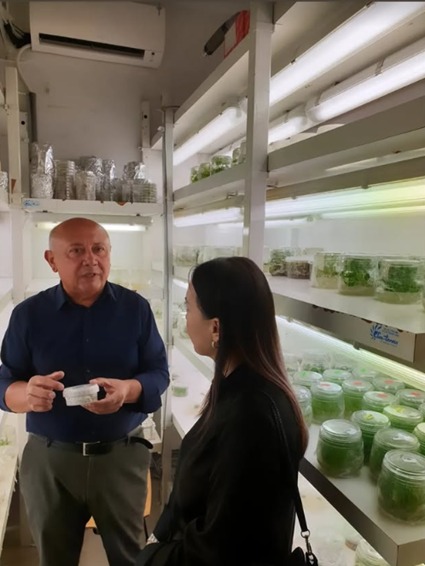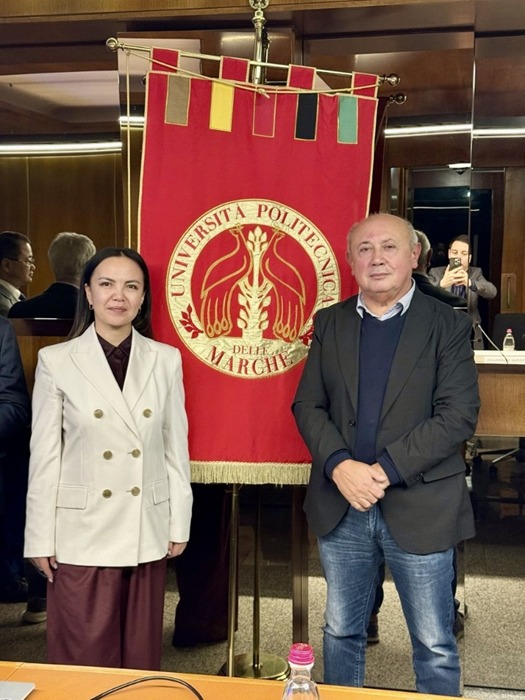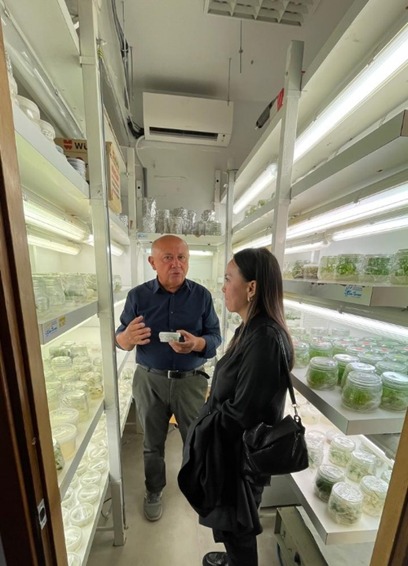
As part of research project AP27510879, “Study and Conservation of Endangered Oxytropis Species Using Biotechnological Methods,” Project Leader Lazzat Naushabayevna Karasholakova undertook a business trip to Marche Polytechnic University in Ancona, Italy, from 16 to 22 November 2025.
The purpose of the visit was to develop and discuss a methodology for establishing Oxytropis specimens in in vitro culture as part of Task 2, scheduled for 2025 in the project’s work plan.
The species of the genus Oxytropis DC. studied within the project are rare and endemic taxa requiring effective biotechnological approaches to the conservation of their genetic resources. Establishing plant material in in vitro culture is a crucial and technically demanding stage when working with wild leguminous species. It requires individually tailored sterilisation protocols and culture media formulations that account for species-specific seed coat characteristics, endogenous microbial loads, and the physiological condition of the explants.
Marche Polytechnic University serves as an international research partner in the project through Professor Bruno Mezzetti, a leading specialist in plant biotechnology with more than 260 scientific publications indexed in Scopus and Web of Science and an h-index of 57. Professor Mezzetti’s extensive experience in clonal micropropagation, tissue culture, and plant genetic transformation informed the choice of this institution for developing the methodology for establishing Oxytropis in in vitro culture.
During working meetings with Professor Mezzetti, the following methodological aspects were reviewed and agreed upon:
Selection of an explant surface sterilisation method. Given the high levels of microbial contamination in seeds of wild leguminous species, a multistep sterilisation procedure was discussed. This included pretreatment with 70% ethanol, followed by treatment with a sodium hypochlorite solution (commercial bleach) at an appropriately selected concentration and exposure time, and a series of rinses with sterile distilled water to remove residual sterilising agents while preserving tissue viability.
Selection of explant types. Seeds were recommended as starting material for culture establishment following scarification to address the hard seed coat characteristic of the genus Oxytropis. Seedling segments and apical meristems were also recommended because of their comparatively low contamination levels and high morphogenetic potential.
Development of the culture medium formulation. Murashige and Skoog (MS) medium was agreed upon as the basal medium, with optimisation of plant growth regulator concentrations, specifically the cytokinin 6-benzylaminopurine (BAP), to induce shoot formation. The discussions also addressed the medium pH and sucrose concentration most suitable for plants of this genus.